
The Parody Before the Passion
Jesus must have looked downright foolish riding into the city on a donkey that day, his legs dangling down so that his toes scraped the dirt and his robe dragging in the dust. (Mark 11:1-11) The story gets stranger when Luke says it was a young donkey on which no one had ridden. Really? A donkey can be pretty stubborn! Depending on the translation, Matthew paints a bizarre scene with two donkeys. “They brought the donkey and the colt and laid their clothes on them. Then he sat on them.” (Matt 21:1-11). It almost looks like a “cold open” on Saturday Night Live.
According to Christian tradition, Jesus entered the capital city on a donkey through the East Gate while the Pilate, the Roman governor, rode in on a stallion with his soldiers through the West Gate. The contrast is obvious. You can look important on a warhorse, but it’s hard not to look foolish on a donkey.
The Palm Sunday parade raises some intriguing questions.
- What if Jesus planned the whole thing as a parody, “a creative work designed to imitate, comment on, and/or mock its subject by means of satirical or ironic imitation”?
- What if Palm Sunday is divine satire that punctures our pretensions of political power?
- What if the man on a donkey is heavenly mockery by the God who laughs at arrogant, human pride? (Psalm 2:1-4)
- What if Jesus is calling each of us to get down off of our high horses and follow him in the way of humility?
They shouted “Hosanna!” that day. The Hebrew word means “help” or “save.” It includes the imperative that gives desperate urgency to the cry. The crowd was shouting, “Save us, now!” They wanted a savior with military, economic, and political power to throw out the Romans and reestablish the throne of David. They wanted a “strong man,” a bully, an authoritarian, a dictatorial leader who would bring down the government, run off the foreigners, and make their nation great again. But that wasn’t the Savior God sent.
How God Saves
The peculiar story we tell this week demonstrates the way God saves, not through the exercise of loveless power, but through what appears to be powerless love. God saves, not through the myth of redemptive violence, but through the model of redemptive suffering. God saves, not by rearranging of the world’s political power players, but by a radical reorientation of the human heart. God saves, not by destroying those who oppose him, but by forgiving those who nailed his Son to a cross. God saves, not by escaping death, but by going with us all the way to the grave.
The religious leaders laughed out loud at the joke, “He wanted to save others but he can’t even save himself!” (Mk 15:31) It turns out that the joke was on them. It was precisely because Jesus refused to save himself that he would save others, including every last, lost, infinitely loved one of us. That’s why Jesus wept as the parade began its march into the city. Barely able to hold back his tears, he said, “If only you knew on this of all days the things that lead to peace … But you didn’t recognize the time of your gracious visit from God.” (Lk 19:41-44)
The deepest truth about your life and mine and about the world in which we live is that we are fools to think that we can save ourselves. The joke is on us if we think we can change the world by the sheer force of our wealth, wisdom, and military power. The man riding into town on a donkey who ends up hanging on a cross may not be the savior we want but he may be the Savior we need.
The Savior I want is the one who helps me help myself; the one who allows me to hide my greed under a cloak of charity, dress up my political prejudices in a robe of religion, and parade through life on the stallion of pride. But the Savior I need is the one who comes in humility; the one who undermines my love of selfish power with the power of self-giving love; who calls me to get down off my high horse and walk with him in the way of humility.
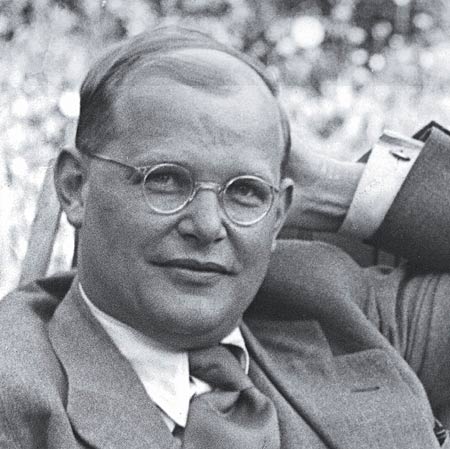
On April 9 we honored the 80th anniversary of the execution of Dietrich Bonhoeffer. My colleague and friend, James Howell, offers an excellent introduction to Bonhoeffer here. Remembering the way he confronted fascism and racism in Germany makes this an important moment for us to read or reread The Cost of Discipleship. During Lent I’ve been living with his Letters and Papers from Prison. This week I read:
The wish to have everything by one’s own power is false pride…
It is not only fear that is contagious, but also the peace and joy with which we encounter what is laid upon us at any given time …
Only when one loves life and the earth so much that with it everything seems lost and at its end may one believe in the resurrection the dead and a new world …
When they took him out to hang him, his last words to his fellow prisoners were, “This is the end–for me, the beginning of life.”
What if Palm Sunday is the day when the one who appeared to be a fool turned out to be wiser than the rest of us? What if the man on the donkey is the one who puts everything else in proper perspective by looking like a fool? What if the foolishness of God actually is wiser than human wisdom after all? (1 Cor. 1:18-25)
If we don’t get the story, the joke may be on us. No fooling.
Grace and peace,
Jim
(Adapted from Easter Earthquake: How Resurrection Shakes Our World, with permission from Upper Room Books, 2017).
 Jim Harnish
Thank you for recommending James Howell’s excellent presentation on Dietrich Bonhoeffer. My first real introduction to Bonhoeffer was my freshman year in college when Prof. Jim King read from Life Together for devotions in Oratorio Chorus rehearsals.
Ric Schopke