
Colliding Headlines
Do you ever feel that you can’t keep up with the “Breaking News” headlines that crash in upon us before we can absorb the last one? Do you ever feel that some stories are so horrendous you don’t want to read or hear them?
That’s how I feel about breaking news headlines that collide in the gospels at Epiphany.
January 6 has been celebrated as The Epiphany of Our Lord since the 4th Century. In the Western tradition, both Roman Catholic and Protestant churches have focused on the Visit of the Magi (Matt 2:1-12). In the Eastern Orthodox tradition, it celebrates the Baptism of Our Lord (Mk 1:4-11). That’s why the boys in Tarpon Springs will dive for the cross for the 118th time today. Some traditions have focused on the Wedding in Cana (Jn 2:1-2) which the gospel calls “the first of his signs that revealed his glory.”
Tucked among those amazing “manifestations” of the glory of God in Christ, Matthew inserts the gut-wrenching story we’d like to avoid but our current headlines will not let us escape.

Only Matthew tells the story of Herod’s slaughter the boys in Bethlehem. (Matt 2:16-18) Leon Cognate captured the horror in Scène du massacre des Innocents (“Scene of the Massacre of the Innocents”). Some scholars point out that there is no external historical evidence for the event, suggesting that Matthew included it for theological reasons. But Cognate’s painting has a familiar feeling. It could be a photograph of parents attempting to protect their children in the rubble of Gaza or amid the destruction in Ukraine today.
Who Was Herod?
Herod was a pathologically insecure narcissist who was obsessively driven by his fear of any threat to his position and power. (Does that sound familiar?) He wouldn’t hesitate to get rid of anyone who questioned his authority. The slaughter in Bethlehem would not be inconsistent with his character or previous behavior. (The Anchor Bible Dictionary, Vol. 3, p. 169)
That’s why he was “troubled” when the magi came looking for a newborn king. The more troubled he was the more troubling he became. If he had social media, he would have gone into a texting fit with raging accusations in bold type. As usual, his first response was to lie. “Go and search carefully for the child. When you’ve found him, report to me so that I too may go and honor him.” (Matthew 2:8)
Holy Migrants
Joseph hardly needed an angel to tell him to get out of there! (Mathew 2:13) We found this carving in a wood shop behind St. Joseph’s Cathedral in Durban, South Africa.
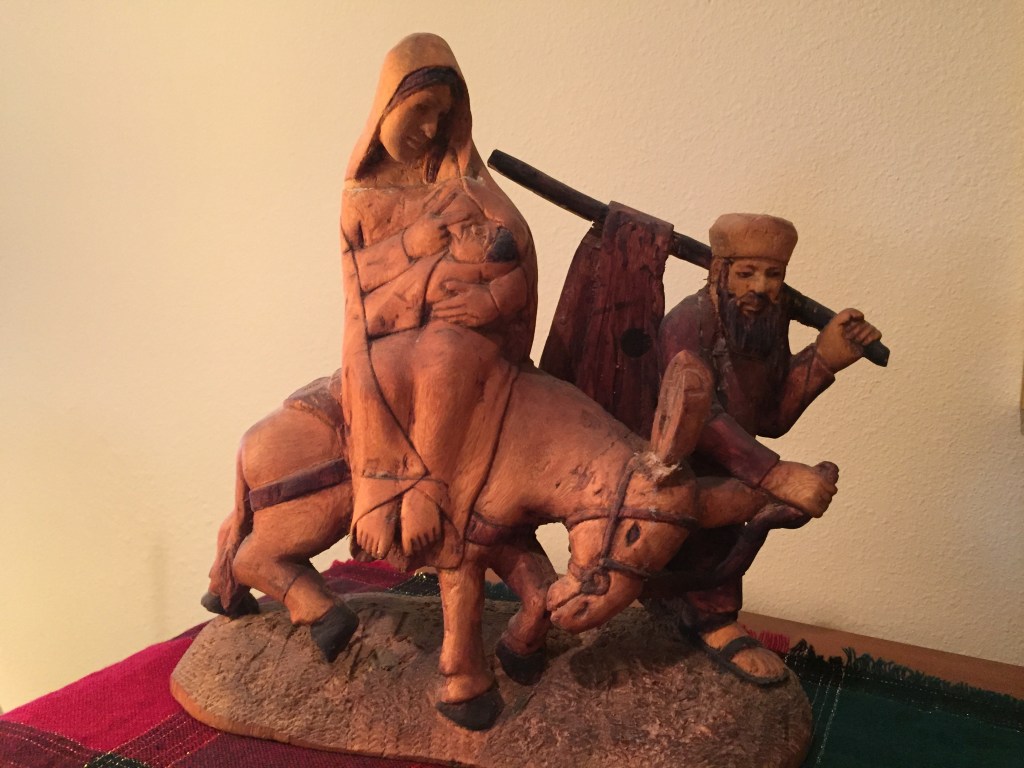
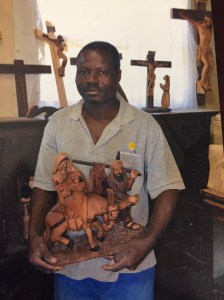
The artist makes his living by carving religious figures from discarded lumber and broken tree trunks. This carving portrays the reality of refugee families in every generation who, like Mary and Joseph, flee from violence or oppression. (Sound familiar?)
I wonder… When Mary and Joseph got to Egypt, who took them in? Where did they find food, shelter, or Pampers for the baby? What difference does it make for us to picture the Son of God waiting to get through the Rafah Border Crossing from Palestine into Egypt?
Why?
Why does Matthew include this story? Why give Herod a leading role opening scenes of the gospel drama?
Matthew was a hard core realist. The former tax collector would have known about financial corruption and political power. His gospel paints a stark contrast between the kingdoms of this world ruled by the likes of Herod and Pilate vs the Kingdom of God revealed in Jesus. In the Sermon on the Mount he collected Jesus’ teachings on how to live the Kingdom life right now. We are challenged to hold every part of our life, every political leader, social system, and institution accountable to Jesus’ vision of the Kingdom of God. We are to be part of the answer to our prayer that God’s Kingdom will come and God’s will be done right here, right now, in us, even as it is already fulfilled in Heaven.
It’s a tough opening to the gospel, but Matthew offered a word of hope when he wrote, “After King Herod died…” (Matt 2:19) Like every bombastic, self-absorbed, autocratic ruler, Herod “struts and frets his hour upon the stage /And then is heard no more.” (Macbeth, Act V) After Herod does his worst, he becomes little more than a secular calendar marker to establish Jesus’ birthday. And when Herod was gone, Jesus returned. (Matt 2:19-23) In spite of everything that contradicts the coming of his Kingdom, his truth goes marching on.
I’m reminded of the way Martin Luther King, Jr., often quoted lines from “The Present Crisis” by abolitionist, James Russell Lowell.
Truth forever on the scaffold, Wrong forever on the throne,—
Yet that scaffold sways the future, and, behind the dim unknown,
Standeth God within the shadow, keeping watch above his own.
The entire poem is well worth reading. It was written on the brink of the Civil War and includes his bold call to action.
Then to side with Truth is noble when we share her wretched crust,
Ere her cause bring fame and profit, and ’tis prosperous to be just;
Then it is the brave man chooses, while the coward stands aside,
And the multitude make virtue of the faith they had denied.
He concludes by pointing toward the future.
New occasions teach new duties; Time makes ancient good uncouth;
They must upward still, and onward, who would keep abreast of Truth;
Lo, before us gleam her camp-fires! we ourselves must Pilgrims be,
Launch our Mayflower, and steer boldly through the desperate winter sea,
Nor attempt the Future’s portal with the Past’s blood-rusted key.
In light of the breaking news of our time, the Epiphany gospel headlines don’t seem so distant after all.
Grace and peace,
Jim
 Jim Harnish
I always love reading your words, but this one just made me shiver. Always such a master at pulling together the historical , the spiritual, and the present day TRUTHS to make the puzzle pieces of all 3 fit together to give your readers the whole picture. I had never seen this particular painting, but right now our church is working on a fund raiser (a musical concert & art sale) to help Ukraine Trust Chain, and this painting says it all. We study and discuss all of the pieces at every meeting, lesson, and sermon. Can’t wait to share this with all of our congregation.
Thank you! You described what I try to do and am grateful when it works!
Jim Exceptionally well written! Thanks. A reminder need today. I hope you guys are doing well. I continue to improve and even abandon my walker for short walks when Jane cannot see me. I am hopeful because today leads to the possibility of future. I appreciate you and Martha’s friendship and your faithful outreach to me. Have a blessed day and SHALOM, Tom Mc
>
Thanks, Tom. We continue to pray for your renewed strength and for patience along the way!
Thanks, Jim.
I am always grateful for your commentaries that quote from your wide knowledge of scripture, poetry, speeches, essays, plays, paintings, sculptures, and other art forms, to make theological points that are relevant to the world today. That is such a refreshing change from “The Bible says it. I believe it. That settles it!”
As one who had very little formal education in the arts (other than music), I have gained so much from your insightful commentaries.
Happy New Year!
Tom
>
Tom: Thanks so much for your message. It means so much coming from a person for whom I have great respect. Hope all is well with you.
Jim
Thank you Jim for these rich spiritual insights connecting scripture with our present moment. I came to this post after reading your commentary from July 2020 on “The Present Crisis” by James Russell Lowell. We will be discussing the poem at our church’s men’s group this coming Friday. I rediscovered the poem on New Year’s Day this year and thought it good food for thought (and discussion) since 2024 promises to be a year of great consequence. Certainly we have come to a moment of decision; and truth is most assuredly on the scaffold.
God’s peace in the midst of it all. Jeff Conlon
Jeff: Thanks for your encouragement. Particularly when you put the poem in its context with regard to abolition, it clearly has a resonance with “the present crisis” we confront. I’ll be interested in knowing how your. men’s group responds to it. God bless! Jim