
The execution of Jesus could not have happened without the actions of two political operatives who betrayed any suggestion of “due process” to get rid of a political problem and protect the Roman Empire.
The Sociopath

If Herod Antipas were alive today, he might be diagnosed as a sociopath.
Mayo Clinic describes a sociopath as a person who “consistently shows no regard for right and wrong and ignores the rights and feelings of others. [They] manipulate or treat others harshly or with cruel indifference. They lack remorse or do not regret their behavior.”
Symptoms include repeatedly:
- Ignoring right and wrong.
- Telling lies to take advantage of others.
- Not being sensitive to or respectful of others.
- Using charm or wit to manipulate others for personal gain or pleasure.
- Having a sense of superiority and being extremely opinionated.
- Having problems with the law, including criminal behavior.
- Being hostile, aggressive, violent or threatening to others.
- Feeling no guilt about harming others.
- Being irresponsible and failing to fulfill work or financial responsibilities.
Sadly, if the Mayo diagnosis suggests the behavior of the week-day resident of the White House, it’s purely intentional.
Herod Antipas evidently inherited his personality disorder from his father. Herod the Great is remembered for his massive construction projects, but he was so threatened by the suggestion of a new king that he sent his troops to slaughter the little boys in Bethlehem. Like his father, when Herod Antipas was offended by the way John the Baptist named the sin of his marital behavior, he had the preacher beheaded. (Matt 14:1-12)
The Pharisees warned Jesus that Antipas was plotting his death, but Jesus was determined to go to Jerusalem anyway. Herod got his chance when Pilate, attempting to escape responsibility for the problem, sent Jesus to Herod. But Herod shipped him back when Jesus didn’t perform any miracles for him. (Lk 23:5-12)
Pilate: The Politician
Pilate plays a lead role in all four gospels. I urge you to stop. Take a deep breath. Read the stories. It will take less time that it takes to get to the first commercial break on the evening news. (Matt 27:11-44, Mk 15:1-15, Lk 23:1-24, Jn 18:28-19:22) How does Pilate impress you?
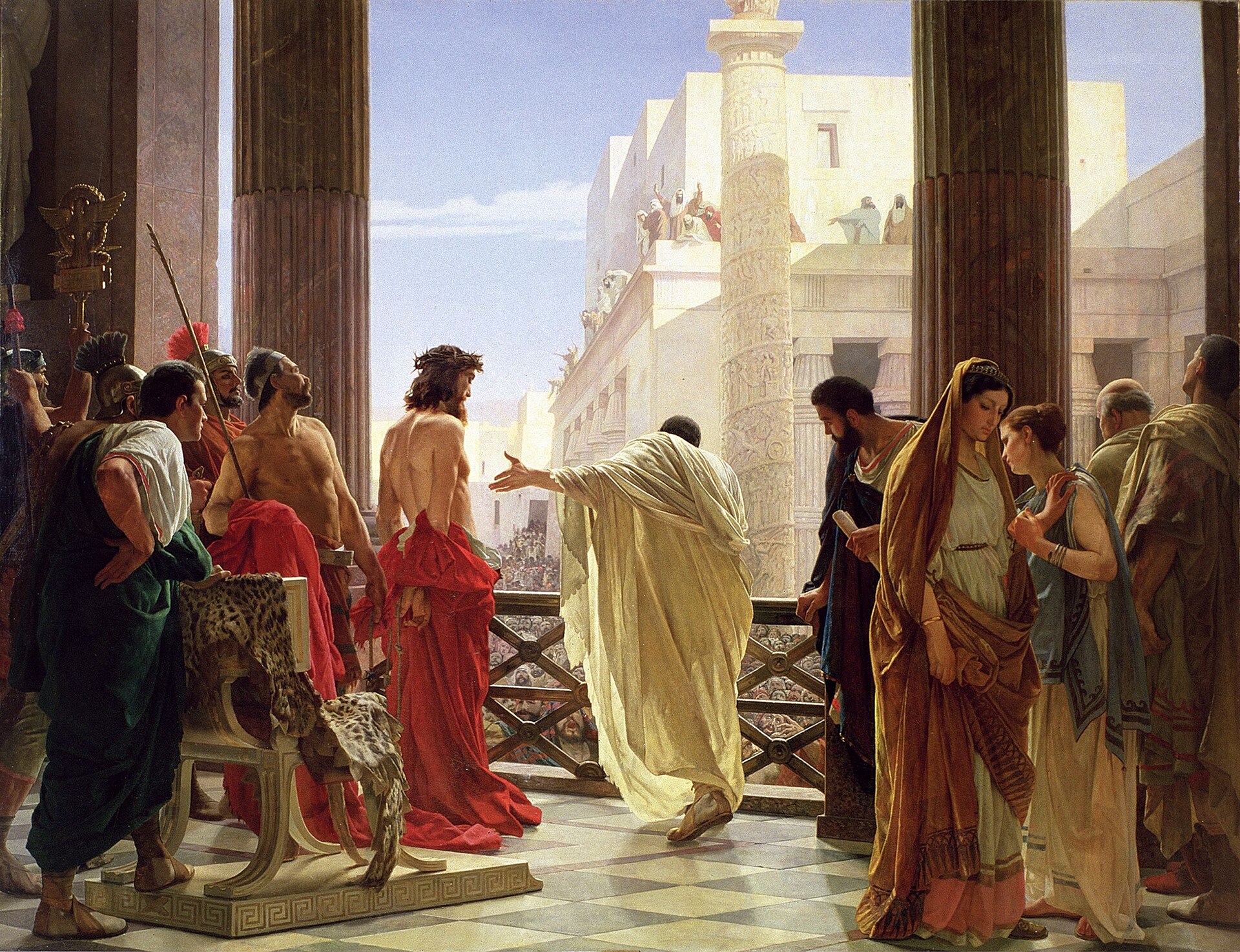
Pilate sees clearly that Jesus is innocent. He tries everything he can think of to release him. But he is afraid of losing control of a riot and of losing his status with Caesar. The final argument is, “‘If you release this man, you are no friend of the emperor.” (Jn 19:12)
Pilate knows better. But he sacrifices his sense of truth and justice for political access and power. If that suggests the behavior of members of Congress and the Cabinet, it’s purely intentional.
Luke records this interesting footnote in the story: “That same day Herod and Pilate became friends with each other; before this they had been enemies.” (Lk 23:12)
Jesus: The Savior
What is left to say? Jesus stands in the unrelenting tension of our conflicting passions, values, compromises, and failures. He goes to the cross for the same old sins of greed, narcissism, bigotry, hatred, and injustice that have plagued humanity in every generation.
He cries out the words that are the persistent cry of every innocent person who is caught in the vice grip of suffering, “My God, why have you forsaken me?” (Ps 22).
He prays for everyone last, lost, infinitely loved sinner (including all of us), “Father, forgive them.” (Lk 23:34) Sometimes we know not what we do, but all too often we know exactly what we are doing and do it anyway.
He gasps his last words of absolute trust in the infinite goodness of God, “Into your hand I commend my spirit.” (Ps 31:5)

In the end, Good Friday leaves us speechless before a suffering love that goes beyond our compression but not beyond our experience. We are left with Isaac Watts’ matchless words, “When I Survey the Wondrous Cross.” I encourage you to experience this arrangement of it.
When I survey the wondrous cross
on which the Prince of glory died,
my richest gain I count but loss,
and pour contempt on all my pride.
Forbid it, Lord, that I should boast
save in the death of Christ, my God!
All the vain things that charm me most,
I sacrifice them through his blood.
See, from his head, his hands, his feet,
sorrow and love flow mingled down.
Did e’er such love and sorrow meet,
or thorns compose so rich a crown?
Were the whole realm of nature mine,
that were a present far too small.
Love so amazing, so divine,
demands my soul, my life, my all.
And so, standing before the cross may we acknowledge our disordered lives, our costly compromises, and are desperate need of the love and grace that God offers to us. It’s the only way to be prepared for a resurrection!
Peace,
Jim
 Jim Harnish
Moving and meaningful! Thank you.
I have never read “executi